Table of contents and map
Gallery of Modern Art Glasgow (GoMA): Visitor Guide and the Story of the Cone
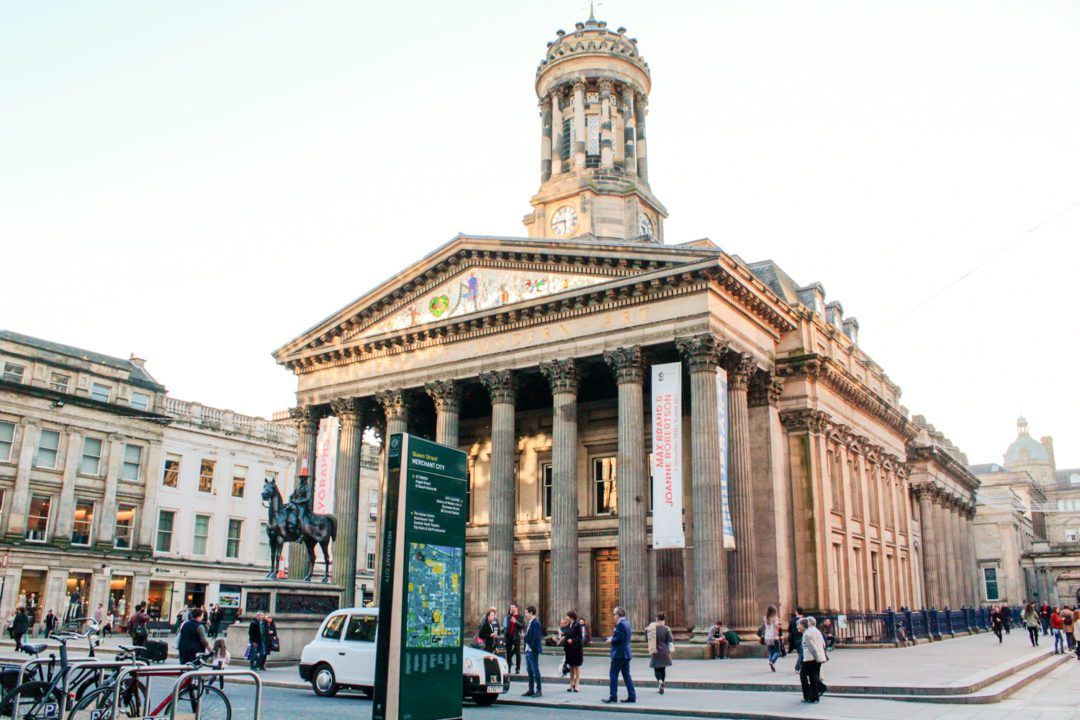
Located in the heart of Royal Exchange Square, GoMA is Scotland’s most visited contemporary art museum. Yet behind its imposing neoclassical columns lies a story of contrasts: from an 18th-century tobacco lord's mansion built on colonial fortunes to a free public space that challenges power. Guarded by the famous statue of the Duke of Wellington with his eternal traffic cone, GoMA is a must-visit on your journey through Glasgow.
Gallery of Modern Art Glasgow (GoMA): Visitor Guide and the Story of the Cone
Located in the heart of Royal Exchange Square, GoMA is Scotland’s most visited contemporary art museum. Yet behind its imposing neoclassical columns lies a story of contrasts: from an 18th-century tobacco lord's mansion built on colonial fortunes to a free public space that challenges power. Guarded by the famous statue of the Duke of Wellington with his eternal traffic cone, GoMA is a must-visit on your journey through Glasgow.
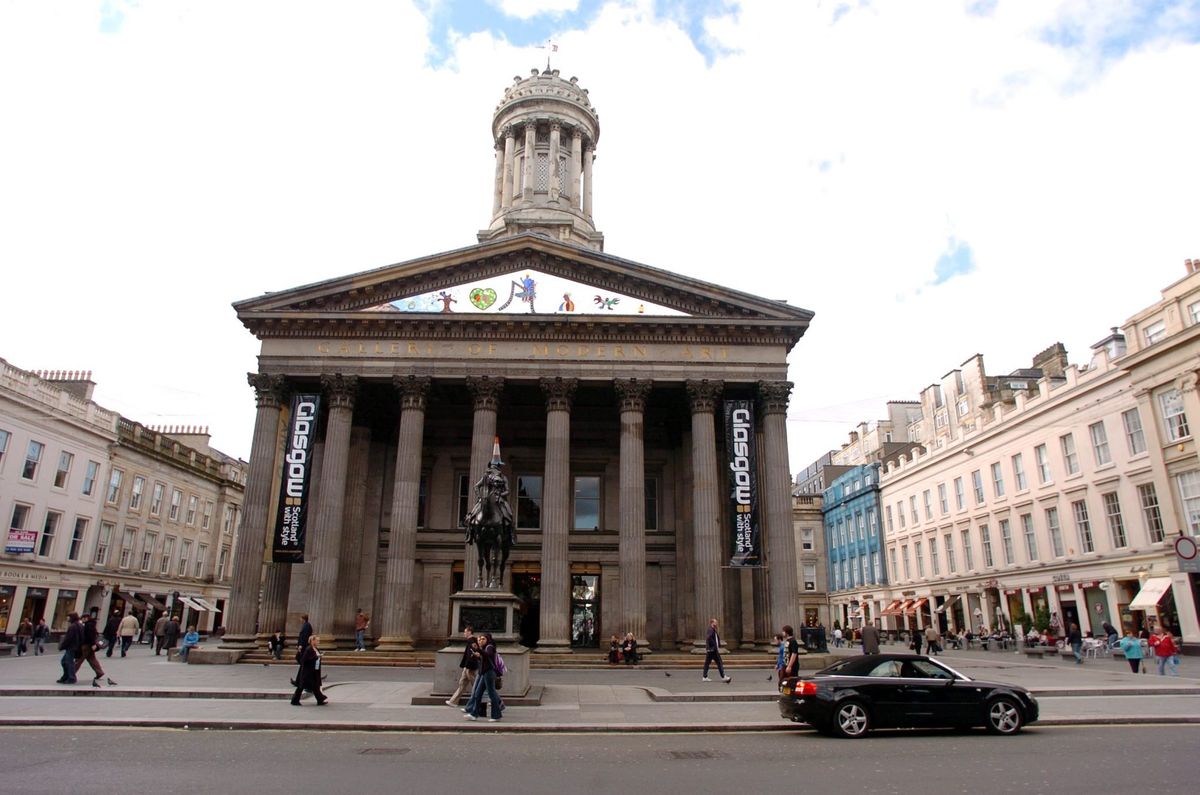
If there is one building that perfectly sums up the essence of Glasgow—its grand architectural past, its vibrant art scene, and, above all, the irreverent humor of its people—it is the Gallery of Modern Art (affectionately known as GoMA).
Located in the beautiful and pedestrianized Royal Exchange Square, right at the end of the bustling Buchanan Street shopping district, GoMA is not just a container for contemporary art. It is a symbol of the city's identity, a social meeting point, and home to the most photographed "monument" in all of Scotland.
The Story of the Duke of Wellington Statue and the Cone
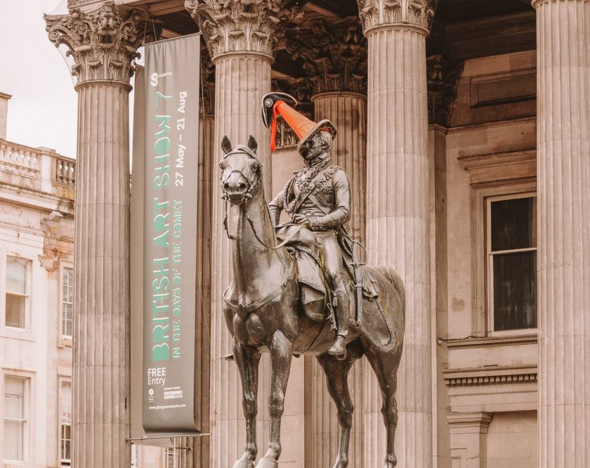
Before stepping through the museum doors, it is an absolute must to stop in front of the bronze equestrian statue of the Duke of Wellington, sculpted by Italian artist Carlo Marochetti in 1844. What has made it world-famous is not its sculptural value, but the orange and white traffic cone crowning the duke's head.
How did this tradition start?
The story began in the mid-1980s as a recurring prank by local students and late-night revelers who, after a night out, climbed the statue to place a traffic cone on it as a hat.
For years, Glasgow City Council and the police removed the cone immediately, arguing that it damaged the bronze and projected a "bad image" of the city. However, by the next morning, a new cone would always appear. In 2013, the council proposed a plan to double the height of the pedestal to deter climbers, which would have cost around £65,000.
The people's victory
The reaction from Glaswegians was immediate: an online petition under the slogan "Keep the Cone" gathered over 10,000 signatures in 24 hours, and a peaceful rally was called. Facing public backlash, the council withdrew the proposal. Today, the cone is officially recognized as a symbol of Glasgow's pride, defiance, and sharp-witted humor, and global brands and official tourism boards use it to represent the city. On special occasions, such as Pride or major sporting events, the cone even changes colors!
The Building: From Slave Traders' Mansion to Public Gallery
The GoMA building is a neoclassical gem with a fascinating and complex history. It was originally built in 1778 as a luxurious residential townhouse for William Cunninghame, one of Glasgow’s wealthiest "Tobacco Lords", whose fortune was directly built on the colonial trade of goods produced by enslaved people on North American and Caribbean plantations.
Over the years, the building lived several lives:
- In 1827, it was acquired by the Royal Bank of Scotland and underwent major remodeling, adding the magnificent Corinthian colonnade and dome we see today.
- It later housed the city’s Royal Exchange.
- For much of the 20th century, it served as the city's public library.
- Finally, in 1996, it reopened its doors after being refurbished as the Glasgow Gallery of Modern Art. The fact that a neoclassical palace built on colonial-era fortunes is now a free public space dedicated to contemporary art—often highlighting social, critical, and political themes—is one of the most beautiful turnarounds in Glasgow's urban history.
What to See Inside GoMA
Unlike traditional fine art museums, GoMA does not house galleries filled with classic oil paintings in gold frames. Its focus is firmly set on modern and contemporary art, displaying works from the 1960s to the present day.
The gallery features four floors of permanent exhibitions and rotating temporary installations:
- Works by Local and International Artists: You can find pieces by renowned Scottish creators like Douglas Gordon, Christine Borland, and John Bellany, alongside international figures like Andy Warhol, David Hockney, and Sebastião Salgado.
- Interactive and Multimedia Installations: Much of GoMA’s exhibitions utilize video art, interactive sculpture, photography, and sound art to address highly relevant current topics such as human rights, climate change, gender identity, and globalization.
- The GoMA Library: Located in the basement, this beautiful public library is open to everyone, offering internet access, study areas, and a specialized art and design section.
Banksy and the Historic "Cut & Run" Exhibition (2023)
In the summer of 2023, GoMA made art history: the elusive street artist Banksy chose it exclusively to host "Cut & Run", his first officially authorized solo exhibition in 14 years. The show included original stencils of his most famous works from 1998 to 2023. Banksy himself stated he chose GoMA because the traffic-coned Duke of Wellington statue outside was his "favorite work of art in the UK."
Ticket Prices and Admission
- 100% Free Entry: Like all municipal museums in Glasgow, general admission to GoMA's permanent exhibitions is completely free for locals and tourists alike. No advance booking is required.
- (Note: Occasionally, very specific temporary exhibitions may carry an entry fee).
Opening Hours (2026)
- Monday to Wednesday: 10:00 AM to 5:00 PM.
- Thursday: 10:00 AM to 8:00 PM (perfect for evening visits).
- Friday: 11:00 AM to 5:00 PM.
- Saturday and Sunday: 10:00 AM to 5:00 PM.
How to Get to GoMA
- On Foot: Being in the dead center of town, it is incredibly easy to reach on foot from any city centre hotel. It is located in Royal Exchange Square, just a 3-minute walk from George Square and right off the busy pedestrianized Buchanan Street.
- By Subway: The nearest stations are Buchanan Street and St Enoch (both just a 5-minute walk away).
- By Train: It is less than a 5-minute walk from Glasgow Queen Street station and about 7 minutes from Glasgow Central station.
Practical Tips for Your Visit
- Combine Your Visit with a Coffee Break: Royal Exchange Square is one of Glasgow’s most beautiful pedestrian plazas. The stone arches surrounding GoMA house excellent cafes with outdoor seating, perfect for a drink after touring the galleries.
- Don't Miss It at Night: As evening falls, GoMA's neoclassical facade is beautifully lit with colored lights, and the square is strung with hanging fairy lights. It is one of the most romantic night views in the city.
- Check Out the Museum Shop: GoMA has one of the best cultural gift shops in town. It is the perfect place to buy postcards designed by local artists, contemporary art books, or unique souvenirs featuring the famous coned statue.
Frequently Asked Questions (FAQ)
How much time do I need to visit GoMA?
The museum is relatively small compared to modern art galleries in other European capitals. A full tour of all the exhibition spaces will take you between 1 and 1.5 hours.
Who is the statue of, and why don't they remove the cone permanently?
The statue represents Arthur Wellesley, the first Duke of Wellington (famous for defeating Napoleon at Waterloo). The police and council no longer attempt to remove the cone daily, having accepted that it has become part of the intangible heritage, popular culture, and tourism draw of modern Glasgow.
Is the museum accessible for people with reduced mobility?
Yes, it features accessible ramps at the main entrance, elevators connecting all exhibition floors, and fully accessible restrooms.
Useful Links to Keep Building Your Scotland Itinerary
Before stepping through the museum doors, it is an absolute must to stop in front of the bronze equestrian statue of the Duke of Wellington, sculpted by Italian artist Carlo Marochetti in 1844. What has made it world-famous is not its sculptural value, but the orange and white traffic cone crowning the duke's head.
How did this tradition start?
The story began in the mid-1980s as a recurring prank by local students and late-night revelers who, after a night out, climbed the statue to place a traffic cone on it as a hat.
For years, Glasgow City Council and the police removed the cone immediately, arguing that it damaged the bronze and projected a "bad image" of the city. However, by the next morning, a new cone would always appear. In 2013, the council proposed a plan to double the height of the pedestal to deter climbers, which would have cost around £65,000.
The people's victory
The reaction from Glaswegians was immediate: an online petition under the slogan "Keep the Cone" gathered over 10,000 signatures in 24 hours, and a peaceful rally was called. Facing public backlash, the council withdrew the proposal. Today, the cone is officially recognized as a symbol of Glasgow's pride, defiance, and sharp-witted humor, and global brands and official tourism boards use it to represent the city. On special occasions, such as Pride or major sporting events, the cone even changes colors!
PUBLICIDAD
Travel with Data: Get your Saily eSIM
- ✓Internet in seconds upon landing
- ✓Flexible plans in 180+ countries
- ✓Easy setup directly via the App
The GoMA building is a neoclassical gem with a fascinating and complex history. It was originally built in 1778 as a luxurious residential townhouse for William Cunninghame, one of Glasgow’s wealthiest "Tobacco Lords", whose fortune was directly built on the colonial trade of goods produced by enslaved people on North American and Caribbean plantations.
Over the years, the building lived several lives:
- In 1827, it was acquired by the Royal Bank of Scotland and underwent major remodeling, adding the magnificent Corinthian colonnade and dome we see today.
- It later housed the city’s Royal Exchange.
- For much of the 20th century, it served as the city's public library.
- Finally, in 1996, it reopened its doors after being refurbished as the Glasgow Gallery of Modern Art. The fact that a neoclassical palace built on colonial-era fortunes is now a free public space dedicated to contemporary art—often highlighting social, critical, and political themes—is one of the most beautiful turnarounds in Glasgow's urban history.
Unlike traditional fine art museums, GoMA does not house galleries filled with classic oil paintings in gold frames. Its focus is firmly set on modern and contemporary art, displaying works from the 1960s to the present day.
The gallery features four floors of permanent exhibitions and rotating temporary installations:
- Works by Local and International Artists: You can find pieces by renowned Scottish creators like Douglas Gordon, Christine Borland, and John Bellany, alongside international figures like Andy Warhol, David Hockney, and Sebastião Salgado.
- Interactive and Multimedia Installations: Much of GoMA’s exhibitions utilize video art, interactive sculpture, photography, and sound art to address highly relevant current topics such as human rights, climate change, gender identity, and globalization.
- The GoMA Library: Located in the basement, this beautiful public library is open to everyone, offering internet access, study areas, and a specialized art and design section.
Banksy and the Historic "Cut & Run" Exhibition (2023)
In the summer of 2023, GoMA made art history: the elusive street artist Banksy chose it exclusively to host "Cut & Run", his first officially authorized solo exhibition in 14 years. The show included original stencils of his most famous works from 1998 to 2023. Banksy himself stated he chose GoMA because the traffic-coned Duke of Wellington statue outside was his "favorite work of art in the UK."
- 100% Free Entry: Like all municipal museums in Glasgow, general admission to GoMA's permanent exhibitions is completely free for locals and tourists alike. No advance booking is required.
- (Note: Occasionally, very specific temporary exhibitions may carry an entry fee).
- Monday to Wednesday: 10:00 AM to 5:00 PM.
- Thursday: 10:00 AM to 8:00 PM (perfect for evening visits).
- Friday: 11:00 AM to 5:00 PM.
- Saturday and Sunday: 10:00 AM to 5:00 PM.
- On Foot: Being in the dead center of town, it is incredibly easy to reach on foot from any city centre hotel. It is located in Royal Exchange Square, just a 3-minute walk from George Square and right off the busy pedestrianized Buchanan Street.
- By Subway: The nearest stations are Buchanan Street and St Enoch (both just a 5-minute walk away).
- By Train: It is less than a 5-minute walk from Glasgow Queen Street station and about 7 minutes from Glasgow Central station.
- Combine Your Visit with a Coffee Break: Royal Exchange Square is one of Glasgow’s most beautiful pedestrian plazas. The stone arches surrounding GoMA house excellent cafes with outdoor seating, perfect for a drink after touring the galleries.
- Don't Miss It at Night: As evening falls, GoMA's neoclassical facade is beautifully lit with colored lights, and the square is strung with hanging fairy lights. It is one of the most romantic night views in the city.
- Check Out the Museum Shop: GoMA has one of the best cultural gift shops in town. It is the perfect place to buy postcards designed by local artists, contemporary art books, or unique souvenirs featuring the famous coned statue.
How much time do I need to visit GoMA?
The museum is relatively small compared to modern art galleries in other European capitals. A full tour of all the exhibition spaces will take you between 1 and 1.5 hours.
Who is the statue of, and why don't they remove the cone permanently?
The statue represents Arthur Wellesley, the first Duke of Wellington (famous for defeating Napoleon at Waterloo). The police and council no longer attempt to remove the cone daily, having accepted that it has become part of the intangible heritage, popular culture, and tourism draw of modern Glasgow.
Is the museum accessible for people with reduced mobility?
Yes, it features accessible ramps at the main entrance, elevators connecting all exhibition floors, and fully accessible restrooms.
PUBLICIDAD
PUBLICIDAD
International Travel Insurance
- ✓International medical insurance
- ✓24/7 immediate assistance in your language
- ✓Ideal for trekking & adventure

Preferences
Language
Color
Text
Width